Overview
This project benchmarks denoising strategies for three-dimensional spectral data cubes of high-redshift galaxies, spanning
synthetic toy rotating-disk cubes, realistic mock IFU cubes from FIRE cosmological simulations, and ALMA observations
(CRISTAL sample and W2246–0526). Methods compared include classical linear decompositions (PCA, ICA), sparse
multiscale denoising (iterative 2D–1D wavelet soft-thresholding — IST), and a supervised 3D U-Net. Performance is
assessed by RMSE, flux conservation within fixed emission apertures, preservation of spectral/spatial morphology, and SNR
improvement.
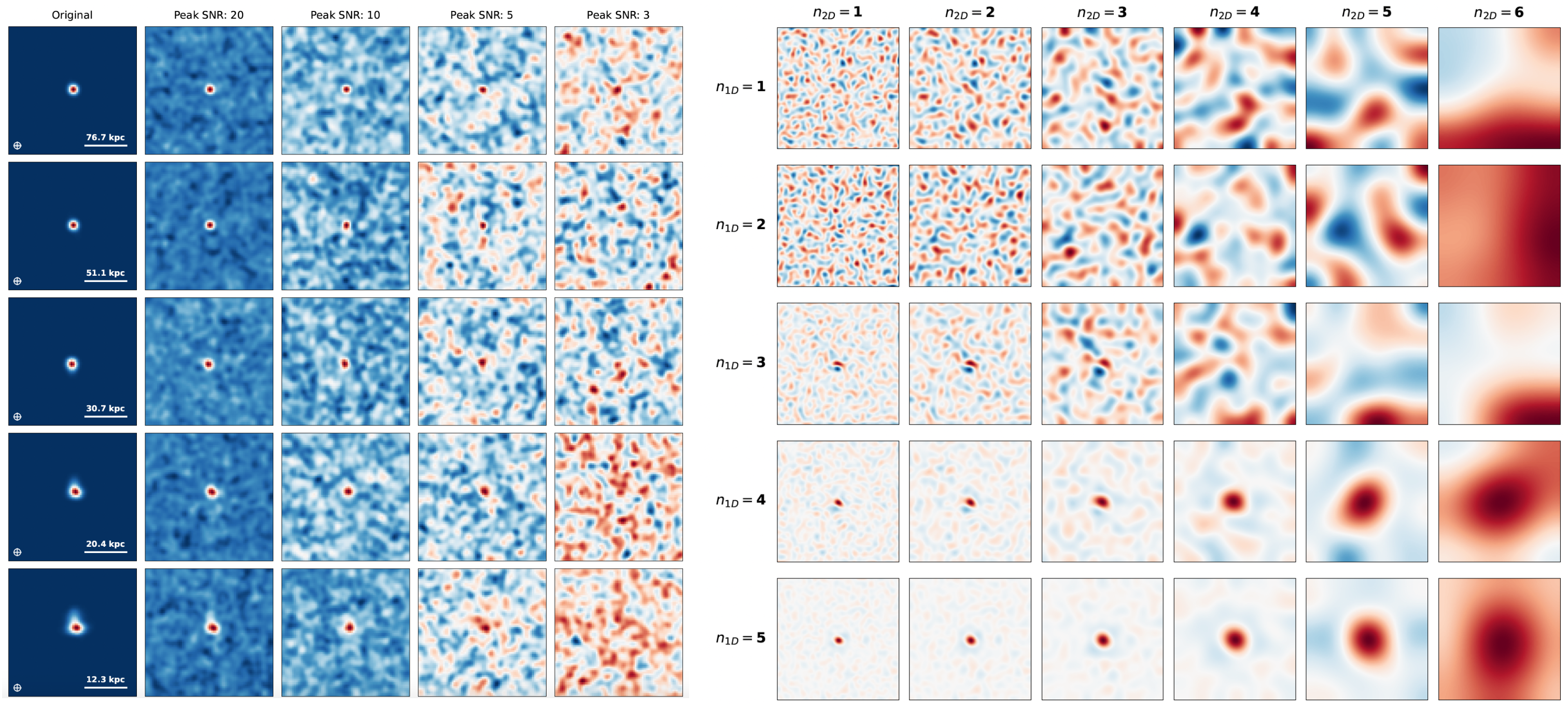 Fig 1. Different levels of noise in toy cubes and wavelet decomposition of one noisy example.
Methodology
The experimental pipeline uses three classes of data (toy rotating-disk cubes, FIRE mock IFU cubes, ALMA CRISTAL & W2246)
and four primary denoising strategies. The toy dataset is physically motivated (Sérsic radial profiles + vertical exponential,
controlled inclination / rotation / beam convolution) and is used to train and evaluate supervised models.
- Data generation & pre-processing: Toy cubes are produced from a 3D flux density model combining a Sérsic radial profile and an exponential vertical profile; cubes are beam-convolved and injected with spatially correlated Gaussian noise at peak SNRs sampled between ~2.5–8.
- Unsupervised baselines: PCA and ICA on reshaped spectra (spaxel×channels) with component-selection guided by flux-plateau or explained-variance criteria; 2D–1D wavelet decomposition (Starlet 2D + 1D biorthogonal spectral wavelet) with iterative reweighted soft-thresholding (IST) for sparsity-driven denoising and a residual de-biasing step.
- Supervised method: A 3D U-Net (encoder–decoder with skip connections, average pooling to preserve flux, LeakyReLU activations) trained on 20,000 synthetic cubes (80/10/10 split) using an MSE loss and Adam optimizer. The architecture preserves spectral–spatial features and learns non-linear mappings to suppress noise.
- Evaluation & apertures: Fixed circular emission aperture defined observationally (aperture diameter $D_{ap} = 2\times\max(De, \mathrm{FWHM_{beam}})$ ) is used to compute total flux conservation and local RMSE within the aperture. Residual noise is estimated with MAD-based estimators to account for correlated noise.
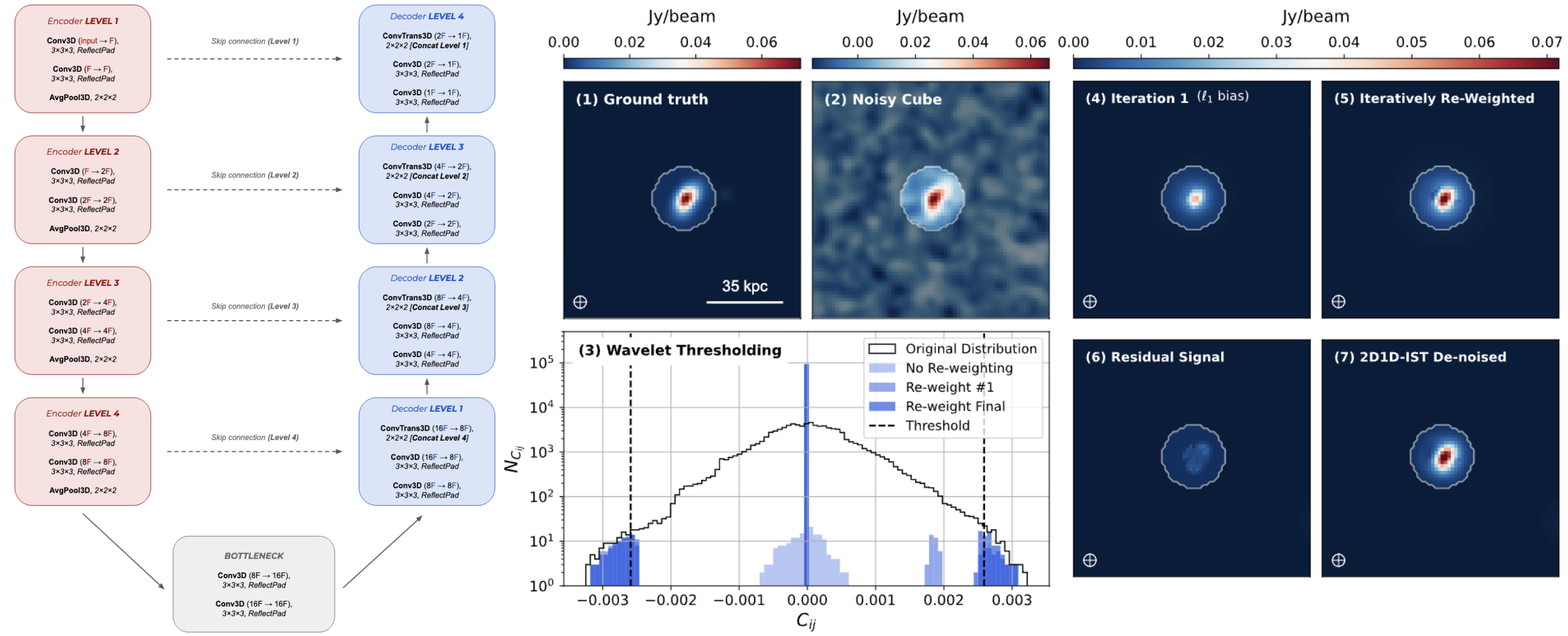 Fig 2. The two main methods: the 3D U-Net architecture (left) and 2D1D-IST denoising of a toy cube, from ground truth and noisy input through wavelet thresholding and re-weighting to the de-noised result (right).
Key Mathematical Framework
The toy spatial flux model uses a 3D Sérsic × exponential law:
\[
S(x,y,z) = S_e \cdot \exp\!\left[-b_n\left(\left(\frac{\sqrt{x^2+y^2}}{R_e}\right)^{1/n}-1\right)\right]\cdot \exp\!\left(-\frac{|z|}{h_z}\right)
\]
where $R_e$ is the effective radius, $n$ the Sérsic index and $b_n$ the standard Sérsic constant (polynomial approx. for $n>0.36$):
\[
b_n = 2n - \tfrac{1}{3} + \frac{4}{405n} + \frac{46}{25515 n^2} + \frac{131}{1148175 n^3} - \frac{2194697}{30690717750 n^4}.
\]
References and derivation in the paper.
Denoising evaluation uses aperture total flux and RMSE within aperture:
\[
S_{\rm den} = \sum_{(i,j,k)\in A} X^{\rm den}_{i,j,k}, \quad
S_{\rm true} = \sum_{(i,j,k)\in A} X^{\rm true}_{i,j,k}
\]
\[
\mathrm{RMSE}_{\rm ap} = \sqrt{\frac{1}{N_p}\sum_{(i,j,k)\in A} \left(X^{\rm den}_{i,j,k} - X^{\rm true}_{i,j,k}\right)^2 }.
\]
Residual noise and SNR improvement are estimated using MAD-based noise estimates to handle beam-correlated noise.
Pipeline Steps (concise)
- Build / simulate toy cubes (Sérsic + kinematics + beam) and preprocess mock IFU/ALMA cubes.
- Train U-Net on synthetic cubes (20k examples).
- Apply PCA, ICA, IST, and U-Net to test / mock / real cubes (CRISTAL, W2246).
- Evaluate flux conservation, RMSE, spectral-shape preservation, and SNR improvement within fixed apertures.
Key Results & Insights
- Classical methods: PCA/ICA provide limited denoising in presence of spatially correlated (beam) noise; they struggle especially at low SNRs.
- Wavelet IST: Iterative 2D–1D soft-thresholding is physically interpretable and conserves flux well in medium-to-high peak SNR regimes (conserves >95% of aperture flux for CRISTAL; strong noise suppression), but tends to lose faint diffuse emission at very low SNR due to conservative thresholding.
- 3D U-Net: Trained on synthetic toy cubes, it generalizes strongly: lowest RMSE across tests, preserves spectral morphology (e.g., double-horned rotation signatures), and achieves the largest SNR improvements (factors ≈6–7 in CRISTAL examples). Caveats: slight flux overestimation / hallucinations at very low SNR and reduced recovery for morphologically very different diffuse systems (e.g., W2246 recovery ≈60%).
- Practical takeaway: A hybrid workflow — IST as an interpretable unsupervised baseline and a U-Net trained on broad synthetic priors (with transfer/fine-tuning on small real samples) — offers a robust route for denoising ALMA / IFU surveys.
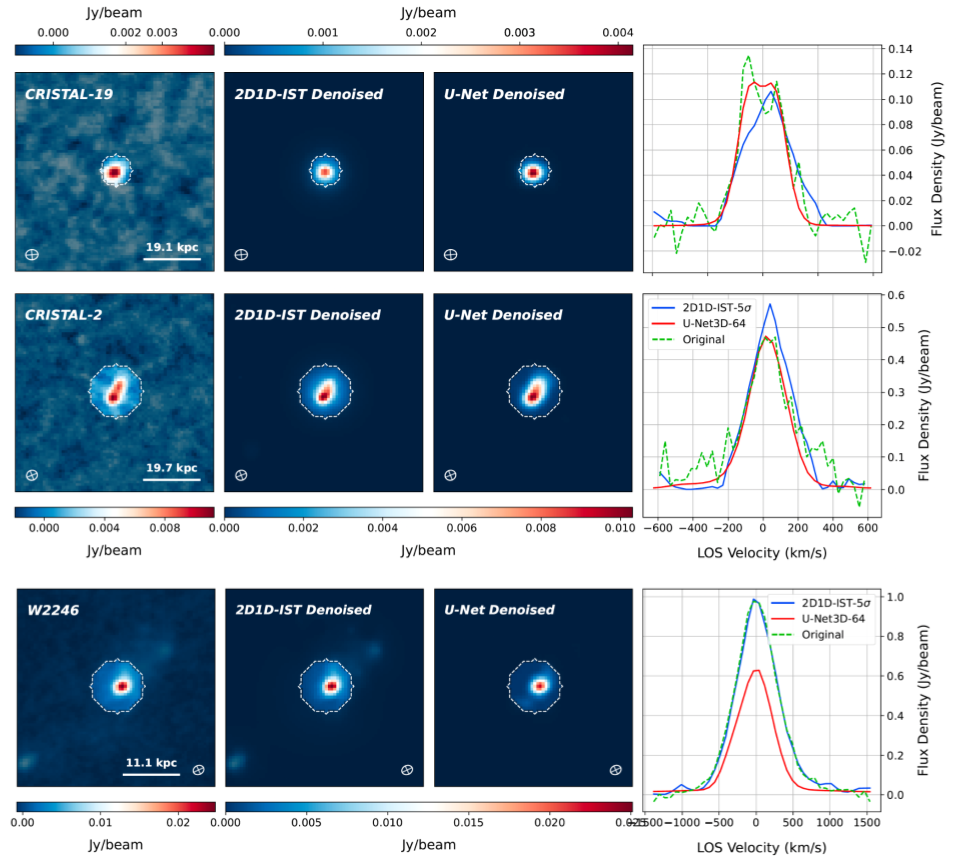 Fig 3. Application to observational data: ALMA CRISTAL-19, CRISTAL-2 and W2246 cubes before and after 2D1D-IST and U-Net denoising, with their spectra.
Representative Numerical Highlights
- U-Net and IST both typically improve SNR by factors >6 for CRISTAL cubes; U-Net conserves >90% of aperture flux in CRISTAL, IST conserves >95% in high-SNR regimes.
- On W2246 (diffuse, turbulent system), IST conserves flux robustly and improves SNR by ≳2.5, while U-Net recovers ≈60% of aperture flux — illustrating limits of purely synthetic training for exotic real morphologies.
Conclusions & Future Directions
Deep supervised denoisers trained on well-designed, physically-motivated synthetic datasets generalize remarkably well to realistic IFU and ALMA data, offering substantial RMSE reduction and SNR gains. However, flux bias / hallucination risks at low SNR underline the need for uncertainty-aware models, hybrid architectures blending interpretable sparse priors with learned filters, and transfer learning to incorporate real-data priors (fine-tuning). The full paper outlines recommended next steps: uncertainty quantification, hybrid learnlet-like architectures, and incorporation of cosmological-simulation priors.